Wednesday, February 16, 2011

Lawrenceville Greenway Circulator

First,
Slow Clap to the Mayor, and URA for this plan.  It’s a great start to making the city more dense with development once again (and green development at that).  This new green development conjures images of Portland and other urban oases. 


As with any re-development plan (unless you’re a sprawling city) the key is to integrate transit options other than automobile based to increase mobility into and out of your new development.*

This newest plan for Pittsburgh’s new riverfront development certainly addresses these issues.  AVR’s branch to 26st street in the Strip has been planned for integration into the development as part of their already proposed commuter rail and also includes an at-grade “trolley circulator” which would traverse Smallman St.  and Penn Ave.

I’ve talked ad-nauseum about AVR’s commuter line (although I will address the addition of another commuter line later).   As a result I’ll focus more on the at-grade trolley topic as well as an oft ignored topic here in Pittsburgh; the water taxi. 

Trolley Circulator

In my mind, you wouldn’t have to do anything to the strip and it would already be a great idea for a tourist centered trolley.  An at grade line on Smallman St. from saaaayyyy the Heinz History Center to the 31st St. Bridge would be great to move people in the Strip on weekends. 

As such it only makes sense that this idea would be incorporated into this riverfront plan.  As written in the proposal, this line would start at the David Lawrence Convention Center and travel at grade up Smallman St. to the 40th St. Bridge, where it would then loop onto Penn Ave back to approx 21st St. where it would rejoin the ROW on Smallman back to the David Lawrence Convention Center. 

As I said before; solid idea.  I also realize that this is just a proposal for the entire project and as such doesn’t go into too much detail on the transportation aspects of it.  However, there are some issues that should be discussed and ironed out.  

First, check out this great primer for streetcar systems over at the Transport Politic.  

There have been a number of streetcar systems established in the U.S. within the past ten years.  What’s even more promising is that some of these have built a successful nitch in traditionally non-transit friendly areas, such as Tampa’s TECO Streetcar and Little Rock’s River Rail. 

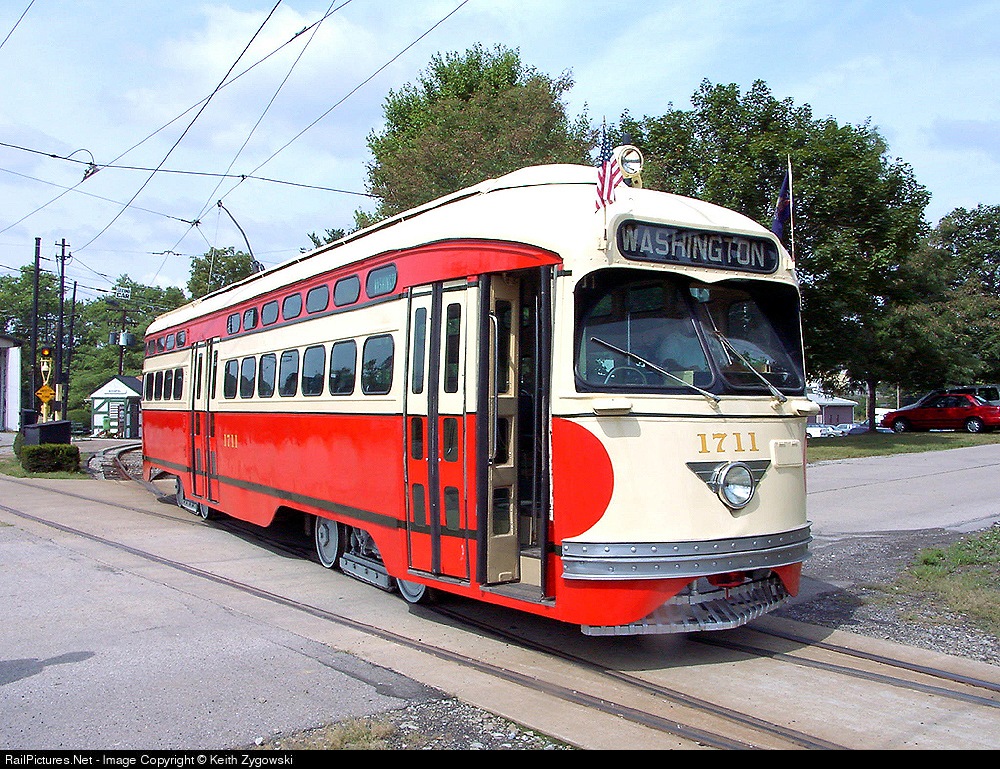
These and other systems have capitalized on the nostalgia aspect of trolleys.  Many lines use either heritage equipment (like San Francisco’s fleet of PCC cars) or new equipment made to look old (like TECO and Little Rock).  It would bring back a lot of memories for Pittsburghers to see trolleys like this


 or this


There is certainly something to be said for marketing your operation correctly and nostalgia is certainly a good way to do it.  However, nothing beats ease of use and good inter-connection.  I like the idea that it spans the entire length of the Strip from downtown all the way to Lawrenceville.  It would be a great way for a Lawrenceville or Strip resident to get downtown or move between the neighborhoods.  

However, the key question which isn’t really addressed here is;  how do you get to the trolley if you’re not one of these residents?  What are it’s connections?  I know there is talk of another trolley circulator to Oakland but that’s a topic for later.  How will someone from the Southside, or the South Hills make use of this trolley without driving to a parking lot in the Strip or Lawrenceville?   The T would make a great connector, but with AVR seemingly going all the way Steel Plaza, that takes away that option. 

Additionally how will someone from Oakland, or Hazelwood, or East Liberty or Garfield get to this line without driving?

 It can be done, after all we’ve got the East Busway for the east end neighborhoods, and supposedly this commuter rail will be an option for people coming from the South, but how this will be integrated and implemented are important discussions that could make or break this operation. 

Lastly, I don't like the idea of putting it on Penn Ave.  I know the plan is to use the circulator to take cars off the streets, in particular Penn Ave. in the Strip.   As a transit guy, I know I’m supposed to believe that putting down rails will take cars off the roads, and I DO believe that.  However, I’m a realist and know a lot of people drive to the Strip on the weekends and that a lot of people will continue to do that as a lot of them are NOT city residents but in fact suburbanites.  I also know that it’s basically bumper to bumper traffic from about 25th St. down through 16th on a Saturday morning.  I think over time that will change but the change will not be immediate.  I think you can get nearly the same effect by putting two tracks in Smallman St. and letting Penn Ave alone.  That said:  it’s not a stake in the heart of the idea. 

The second issue is more of a practical nature.  If you have one track on Smallman and one on Penn, you are creating two at grade crossings of the AVR’s commuter line should it follow its proposed route on 26th St.  Two rail operations crossing at grade are more complex than a road crossing a railroad at grade.  It involves more circuitry, and electronic systems to accomplish.  Why do it twice within a few blocks, making redundant systems when you can do it once, on Smallman St?  You’re not chasing passengers away by having the route one block away with the relatively narrow blocks in the Strip, and you’re saving money on implementation and operating costs. 

Overall, I'm clearly on board with this.  I think it's a great idea and the Strip is a great place to do it.  However, there are some issues that will have to be fleshed out before this aspect of the Riverfront plan could be implemented.  


I was going to cover the additional circulator to Oakland in this post, but seems as though I am rambling and will probably cover that and the “proposed” North Hills to Hazelwood commuter line at the same time. 

Next up:  Water Taxi


*As an aside, that was a major failure with earlier re-development projects in the Pittsburgh area.  The water front is nothing more than a dressed up strip mall with oceans of pavement.  The South Side works, although denser development has few options for transit and no room for transit expansion.  

Monday, February 14, 2011

Lawrenceville Greenway

A full report's finally available on the city's plan for the new "Greenway" which would extend from the DLC to the city line.

Not all of it's transit related, but there are some interesting nuggets, including a trolley "circulator" between Dahntahn and Lawrenceville, some sort of additional circulator between Lawrenceville and Oakland   The oft mentioned commuter rail has popped up once again.  This time including an extension on the old CSX P&W subdivision between Allison Park and Hazelwood (huh?)

I'll have more to say later, but in the mean time; here's the link.

Wednesday, January 19, 2011

In Happier News

Fresh off my previous rant, it's good to see some positive news.

Check it aaaaaaht

It'll be nice to have the Port Authority join the 21st century.  I look forward to more smart card machines than one can count!

“T” Gate

*Disclaimer*  I usually try and be pretty fair, using facts to support my arguments.  This is strictly my opinion.  If at any point you become offended, stop reading and close your browser window.  I’ll be back to the regular old stuff soon enough. 

Enough of this crap. 

It’s getting really ridiculous to see ATU 85 once again shoot the Port Authority, and in turn, themselves in the foot to prove a point.  What that point is, I’m not exactly sure. 

I do know what is being said, however.  The ATU 85 is saying that the Port Authority’s “T” schedules are impossible to follow without violating speed restrictions.  All of this supposedly came about after an external safety audit of PAT operations.

The Port Authority is coming back and saying that the speed limits have not changed in over 12 years. 

I can’t unequivocally say I know that this is the Union’s fault and not PAT’s.  However, judging from the contract “negotiations” of 2008 where the Union threatened to strike because of a minimal increase in healthcare costs, and a lot of the stupidity I have heard roll out of Pat McMahon’s mouth over the past few years, I’m siding with the Port Authority. 

Again, I’m not sure what the real point of ATU 85’s shenanigans are.  If their point is that the 15% service cuts are bad, then address that, pissing off commuters on the T is in no way that my feeble brain can comprehend productive.  All they are doing is adding a disgruntled third party.  A third party that can either support the Port Authority, and in turn ATU 85 or harm the Port Authority and in turn ATU 85. 

In fact, the biggest thing the Union can do to screw itself is to give the taxpayers the impression that they are overpaid and that they underperform.  Right now, it seems like they are right on track to screw themselves.  In the face of extreme budget uncertainty and while they are some of the highest paid transit operators in the Nation, the ATU 85 has decided to go toe to toe with the Port Authority by delaying trains…BRILLIANT!

As I said, I have no idea what this is really about, but I do know what this is accomplishing.  It’s further eroding the faith in public transportation and the Port Authority, by no fault of its own; and could ultimately lead to even GREATER layoffs and service cuts in the future.  

Tuesday, January 11, 2011

My Man

A little candor is refreshing every once in a while. 

Cheers to Ed Rendell!

Transportation Ignorance

I like to make fun of the Trib, but I have to hand it to them, they've been all over the transportation/infrastructure stuff!

Check out this article from yesterday's Trib

This article seems to provide a really good barometer of Pennsylvania's public opinion concerning our transportation and infrastructure situation. 

The bad news is everyone appears not to care.  At least not enough to address it.  My crack analysis shows that only a little more than a quarter of your average Pennsylvanian thinks that transportation and infrastructure should be a priority for our incoming state government.  The silver lining to that cloud is that we Pittsburghers seem much more keenly aware of the issues facing our Commonwealth when it comes to repairing our infrastructure and upgrading our transportation systems.  Given the general apathy, I'm sure the rallying cry for the next four years at least will be much the same as it has been: "Don't take my money to pay for your fancy shmancy public transportation" 

Given the low numbers, it's not suprising to see that a majority of those interviewed would not support higher costs to support infrastucture/transportation improvements.  Even less suprising is that those numbers are highest in rural areas. 

The biggest question I have is: why don't people care?  Eventhough Corbett has pledged up and down he will not raise taxes, he, and his appointed transition committee members seem keenly aware of the poor state of our infrastructure.  Why doesn't your average Pennsylvanian feel the same sense of urgency?  The news on the state of our infrastructure has not been kept in the dark.  Yet, most people are still concerned with lower taxes than a bridge collapsing, or getting cars off the roads. 

Monday, January 10, 2011

Should we add railroads to the list of Passenger Rail enemies?

A lot of HSR stuff in the news.  It’s no secret that Obama’s vision for a national High Speed Rail network is under attack.  Many newly elected officials are far from passenger rail fans.  Everyone’s heard about what’s happened in New Jersey, Wisconsin, and Ohio.  Meanwhile, what should have been a milestone event in Illinois turns out to have simply added more fuel to the anti-rail fire. 

While I do not buy in wholesale to the premise of the article, it brings up some very practical and real issues with the implementation of the Obama Administration’s implementation of HSR and with expansion of our passenger rail network in general.  The biggest and most interesting, in my mind, is the buy-in of the host railroad.  The article surmises among other things that Union Pacific may have “driven a hard bargain” to Illinois and Missouri in exchange for their cooperation with the project.  To me, when they say “hard bargain” they mean $$$.  By money I have a feeling they mean state contribution for upgrades to infrastructure including track and signaling equipment.    

I understand Union Pacific, like all freight railroads want to protect their profitability.  They make their money by moving freight, after all.  However, it’s disconcerting to see they are willing to accept negative effects to our national transportation infrastructure so they don’t see a reduction in their margins. 

The freight railroads, for the most part know they have a captive audience.  Most operating rights of way in this country are private and are owned by corporations.  Any public agency or partnership that wishes to expand service must cooperate with the freight railroads and basically must submit to whatever conditions the carrier lays out, or risk outright refusal to cooperate.  There are legal means to get around this refusal, but a profitable freight railroad is much better equipped to handle a potentially protracted court battle than a coalition using funding which is tight to begin with.  Also, let’s face it, a lot of transportation projects, especially rail projects often face significant opposition, and a public legal battle would not help the situation. 

We’ve seen similar issues here in Pennsylvania.  Look no further than the Keystone Corridor which on paper extends from Philadelphia to Pittsburgh.  In reality, the section from Harrisburg to Pittsburgh is little more than a line on a map.  Between Harrisburg and Philadelphia multiple electric powered trains per day whiz back and forth at maximum speeds up to 110 mph.  West of Harrisburg, a lone diesel powered daily train takes riders to Pittsburgh.  While the line from Philadelphia to Harrisburg sees only local freight service and is owned by the state, the line west of Harrisburg is one of two major rail arteries between New York and Chicago, and is owned by a private company (NS).  Even though there is room to expand (the line was once 3-4 tracks for its whole length, and is now 2-3) NS has gone on record saying that it will require significant investment from public sources for NS to buy in on any service expansion to Pittsburgh. 

Another example is the ongoing Commuter rail saga here in Pittsburgh.  This time last year, it seemed almost a foregone conclusion that Pittsburgh would be gaining two rail lines; one to New Kensington/Arnold via the AVR, and one to Greensburg via the NS.  By July however, NS’s tune apparently changed, as they became “highly unlikely to allow commuter trains on their tracks”.  As a result, we’ve gone from a dual line heavy commuter “system” to a single line light rail system.  While it’s impossible to know what changed, clearly something did. 

Freight railroad's lack of cooperation in allowing passenger operations on their rails is understandable but detrimental to our nation transportation network.  The only real way to get them to help is to force them to.  Unfortunately, that is a thorny subject.  A lot of people in this country don’t like when the Government tells companies what to do.  Additionally, just like every other lobby, there’s a lot of money behind the railroad lobby and any legislation forcing railroad compliance would have to fight not only political will, but good old fashioned money. 

I have to wonder what the answer is.  I for one don’t know.  It’s hard to see our national rail network ever expanding if railroads themselves will make it cost prohibitive.   

Wednesday, January 5, 2011

Mid-week Train Links

Here’s a couple of links I found today, both rail related.

First, in the total surprise department, the Trib issued a transportation (other than auto)  friendly column yesterday. 

Check it out here

Before you get too excited, links at the bottom of the page are a little less Bizzaro-Trib in nature.  After reading this article you can find out how “liberals” have been proven to be “stupid”. 

Enough attempted humor.  The article is dead on, and fits in well with what experts in transportation and infrastructure have been screaming into deaf ears.  Our transportation system is second rate and getting worse, because as we aren’t spending money to fix it and integrate it.  In this country, if it’s not about cars it’s a conspiracy against our Freedom, or some such nonsense.  While we are busy doing this:

See no evil

the rest of the world is improving its infrastructure, in this case its rail systems. 


SecondThis link comes from the Post Gazette.   Apparently the midst of a budget/funding crisis where the fare from every rider counts is the perfect time to practice Union tomfoolery. 

I am a pretty progressive person (especially when it comes to transportation, which should be no suprise) but there’s nothing like cutting off your nose to spite your face.  Apparently purposely screwing with people’s schedules and pissing off the riders is a great way to stick it to the man. 

What is this, kindergarten?  Grow up; you make a lot of money for what you do, and your employer is in a constant state of funding distress.  The last thing the Port Authority needs, and deserves is a black eye because some self-entitled workers want to stick it to them.  

Tuesday, December 28, 2010

Why not a Gondola???

First things first; I learned a valuable lesson early on while researching for this post.

An aerial tram is about as closely related to a gondola as a housecat is to a lion.  While trams and gondolas both travel through the air, are suspended and propelled by cables mounted atop towers, there are some key differences.  (All numbers are approximations and depend on system length, # of vehicles etc.)

Tram               Gondola
Cars/system                                1-2                  10+
Cost/line                                    $15-50 mil       $8-15 mil
Carrier Cap.                              20-50               4-12
System Capacity                        2000/hr            2400+/hr                                             


This idea of an aerial gondola in Pittsburgh popped up a little while ago, and is very intriguing to me.  The idea has been pooh-poohed and at first glance, that notion seems to be accurate.  They’re slow, and can only travel in straight lines without significant upgrades to infrastructure and increases in cost.  Some people may also argue that they are an eyesore high in the sky.

I for one think it’s worth a second glance.  First of all, we’re not trying to connect to the airport here.  This system could be successful as a link within the most dense parts of the city.  Secondly, when compared to the cost for an at-grade or underground rail system, you are looking at an absolute blockbuster bargain (an underground link between downtown and Oakland was estimated at over $1 Billion with a B and an at grade system has been estimated at over $100 million).  An additional positive aspect of an airborne system is the miniscule infrastructure footprint when compared to at grade or underground systems.  Lastly they’re not as slow as you think.  
Detachable technology allows the gondolas to separate from the cable while in a terminal and move independently from the cable which operates at a constant speed.  While the gondolas travel at a literal crawl in each station, they can actually travel as fast as 20 ft/sec once under way.  When you combine that with the fact that they travel in a complete straight line towards their destination, you could be looking at a trip between Oakland and the Southside in a mere 5 minutes.  Five minutes all while taking in beautiful views of our beautiful city.  

Here’s a few interesting reads:


Well, I couldn’t just sit idly by with all this new-fangled and novel transit talk going on and not flex my Google Map muscle.

Essentially, I tried to create a circulator that would take you from nearly any “city core” neighborhood to another relatively easily.  Station placement is key in this scenario because there would be no “intermediate stops” on a given line.  Therefore, easy access to TOD and or other transit is critical for this idea to work.

The system would consist of five color coded lines.  Each line would tie directly into another line at a terminal building and would operate in both directions.  This is to facilitate easy and quick transfer from line to line without a rider having to leave the relative comfort of an enclosed terminal.  Each gondola would ideally hold between 8 and 10 people, and each line would have enough gondolas to keep any transfer time under a minute.   Payment would be rendered at the intial entry station, and an unlimited number free transfers could be made, until a person exits a station and the system. 

Lines:

Blue: Oakland Campus.  This line would connect Fifth Ave. with the Sports Complex.  Would also tie into the Yellow Line at Fifth Ave. and the Red Line at Pitt’s Upper Campus. 

Yellow:  Oakland to Southside.  This line would connect with the Blue Line at Fifth Ave, and the Orange Line in the South Side. 

Orange:  Southside to Mt. Washington.  This line connects with the Yellow Line in the Southside, and the Green Line at Mt. Washington

GreenMt. Washington to Uptown.  This line connects with the Orange Line at Mt. Washington, and with the Red Line Uptown. 

Red:  Uptown to Upper Campus.  This line connects with the Green Line at Uptown and with the Blue Line at Pitt’s Upper Campus.   

Stations:

Upper Pitt Campus:  This station serves the Upper Pitt Campus and Hill District.  This station increases the potential for Pitt Students to use the gondola as an alternative to walking up the hill or using a shuttle.  For this service to work however, some sort of free fare system for students would have to be worked out. 
Oakland:  This station would provide access to the heart of Oakland with the Pitt Campus and hospitals.  It would also provide good transit access with the bus routes which traverse 5th Ave and Forbes Ave. 
South Side Flats:  This station would be best situated between the Southside works and Carson St.  This would allow easy access (2-3 blocks in either direction) to the attractions at the Southside Works and Carson St.  This stop would also tie in well with Port Authority service on the South Side. 
Mt. Washington:  This station would offer easy access to the Mon Incline and views of Pittsburgh
Uptown:  This station would tie in very well with Current re-development plans for the Civic Arena site and the Consol Energy Center.  The only potential issue with this stop is it does not tie in well with transit downtown. 


View Fun With Aerial Gondolas in a larger map

Again, this is by no means a hard and fast plan, but a mere suggestion at how and aerial gondola could be made a very well patronized, inexpensive, and viable form of intra-city transportation in the City of Pittsburgh.

Tuesday, December 21, 2010

Winter What?

It’s hard to miss signs of the 2011 Winter Classic between the Pens and Washington Capitals taking place in just over 11 days.  I for one am ecstatic; between the Alumni game and Classic itself, this an exciting time for hockey in Pittsburgh. 

How is this related to transit you ask?  Well, check out this segue. 

The only organization in Pittsburgh that doesn’t seem to know there is an event at Heinz Field on the 1st of January is the Port Authority.  I understand they’ve been pre-occupied, with the budget crisis, but still, this is a HUGE event for Pittsburgh.  Unlike your average Steeler game (which has a number of transportation options to choose from), a lot of people will be from out of town.  A lot of those same people will be staying in City and area hotels and will be looking for a good way (other than paying $100-$500 to park within a mile of the stadium) to get to the stadium. 

If you look at the Port Authority’s website, you’d think that nothing is going on.  A spin of the ole' trip calculator between anywhere and Heinz Field reveals no special service options, detours or announcements in conjunction with the Winter Classic.

 Meanwhile, a casual search of the internets revealed about 30 different forum threads on various websites from out of towners looking for ways to use public transportation to get to the game. 

This event has already been great for Pittsburgh.  We, as a city look awesome in everything from the advertisements to HBO’s series "24/7".  Pittsburgh likens itself to a progressive and “greening” city committed to livability and sustainability.  That image doesn’t really jive with a transportation authority who, from all appearances, is not concerned with providing quality transportation alternatives to driving for arguably the biggest sporting event in Pittsburgh this year. 

It seems that to the Port Authority, it’s just another weekend holiday on an un-remarkable winter day.  

Monday, December 20, 2010

AVR Commuter Rail Operations Part 3

Vehicles


The end is in sight! 
This final portion of my series on the proposed AVR Commuter line will cover equipment.  It’s been decided, for better or worse, that the AVR’s plan will not use an FRA-compliant heavy DMU, ala US Railcar.  Instead they will use a light DMU.  There are plenty on the market in Europe, and there are several operating examples in the United States

I’ve quoted the RiverLine a lot and they use a version of Stadler “GTW” line of vehicle.  This line is also used by Capital Metro in Austin, TX, and is the proposed vehicle for a new start up service in Denton County Texas

Other manufacturers with a foothold in North America include Siemens Mobility, whose Desiro design is used by Southern California’s Sprinter service and Bombardier whose Talent vehicle was chosen for Ottawa’s “O-Train”.

To be honest, that’s about the extent of the information.  Plenty of company propaganda, but little other information.  I’m not privy, of course, to pricing and what types of options the AVR would include, but if they’re married to a light DMU, then there are at least a number of options to choose from.  


Wednesday, December 15, 2010

By The Skin of their Teeth…

Whew….I can take a breath for now at least.  Funding is by no means secure for the future, but things look good today.


Here’s to the small victories. 


Very emblematic of the struggle within the state for transportation funding.  The groups that seemingly had little stake in the funding crisis voted “NO” overwhelmingly.  Those in Allegheny County and in areas that had the most to lose voted overwhelmingly “YES”.   It’s more of the classic “My taxes should only go to pay for my roads.  Screw everyone else.”

It’s sad to see that such parochialism exists even within the council.  I’m sure everyone believes they are voting in the best interest of the region (or at least that’s what the point of the SPC is).  However, there are clearly divergent views on what’s important. 

I for one don’t understand how you can let the largest population density in the region (and the economic production that goes along with that) to flounder without proper transportation assets and expect it not to affect more than just Allegheny County.  Washington County realized that, I can’t believe that some of our other neighbors (namely Westmoreland, Butler and Beaver Counties) could not, or chose not to recognize that fact.    

Tuesday, December 7, 2010

Nothing Set in Stone

First things first.  Don’t call it a bailout (that goes for you too PG).  That insinuates the Port Authority immediately screwed something up*.  The Port Authority didn’t say; “Hey, let’s throw away our state funding on hookers and blow!”  The state promised dedicated funding for public transportation.  Their plan was arguably a stupid idea and they had no plan B when it didn’t work.  Now they can’t balance the budget while providing a sustainable transit funding source.  The blame for this immediate crisis lies with the state.


Apparently, some on the committee are saying that this is just another band-aid.  I would agree.  No one thinks this is permanent.  However, I would also argue the Port Authority shouldn’t be pushed off the cliff to prove a point. 
  
Permanent funding absolutely needs to be established.  Forcing the Port Authority over the edge and using Western Pennsylvania’s transit users as pawns in the process is not the right way to bring about the needed change. 

The move is meant to buy time to allow steady funding to be established WITHOUT the massive cuts, increased wear and tear on roads, and increased traffic headaches that will occur as a result. 

Not helping the cause is the fact that there seem to be some clear highway advocates within the SPC, especially in areas that are not densely populated and do not have a big public transportation footprint. 

Chairman Charlie Camp seems to be a leader among them, stating: 

"We're tired of the mass transit funding issue coming at the cost of highways and bridges and being put on our table."

I believe that to be a short-sited and erroneous statement.  The money is coming from projects that were not started.  This money would not have been spent on improving our highways.  Additionally, if the cuts are allowed to go through, they will cause major increases in road usage, and therefore increases in wear and tear on our already tired roads and bridges.  Not spending the money to keep the Port Authority going is NOT going to help Western Pennsylvania's roads.

Bottom line, it looks like it’s going to be yet another nail biter in this already very nervous year for the Port Authority and their riders.

If you care about keeping service at least at status quo, then here are a couple of contacts:

To reach the General Comments address:  comments@spcregion.org

To reach the Transportation Planning Directordipietro@spcregion.org


*As I've stated before, the Port Authority has done plenty over the years to warrant anger towards their financial situation.  However, this particular situation has nothing to do with the current regime at the Port Authority.  It's also easy to blame the Unions.  It's true that their negotiated advances did a lot to push us towards this point.  However, the Unions have a legal contract in place and Steve Bland cannot just legally back out on that contract and make the sweeping changes that are called for in some circles.  

Thursday, December 2, 2010

Crisis...Averted?

I found this by way of PGH is a City this morning.

Here's the story.

Rendell has found funding.  That part is good.  As of right now, we don't know if the Southwestern Pennsylvania Commission will approve the "flexing" of $45 million in funds to cover the Port Authority funding gap.  They will meet to decide on December 13th.  If you'll recall, over the summer the Commission voted unanimously to turn down a one time "flex" of money from the Governor.  That was then, this is now.

At that point there was hope that a long term solution was still a possibility so in many ways it made sense that the commission would vote the flex down.   Now that we are down to the wire, they will hopefully approve the measure.

 Key word here is hopefully.

Another key issue is, this is just a temporary stay of execution so to speak.  It's a one year, one time cash infusion that will do nothing to solve the perenial funding issues facing the Port Authority.

However, at this point, I'd be glad to take just about anything that will help stave off the cuts.

Tuesday, November 30, 2010

AVR Commuter Rail Operations Part 2

Signaling

First off, in a different post I used the traffic light analogy when describing a railroad signaling system.  That’s partially right.  For a much better and in depth description of railroad signaling, and different types of railroad signal, check this out. 

As it stands right now, none of the current AVR line mentioned in this proposal is signaled.  Signals were removed from this route back in the PRR days.  This means not only that all the signals and associated relay equipment will have to be re-installed, but any other remotely controlled switches/derails*/automatic stops** etc.  and their associated relay equipment would have to be installed.  This is a normal cost associated with setting up a commuter operation. 

Additionally, special signaling would have to be supplied for the portion that runs at-grade on 26th street and on the Busway. 

Here’s the good news.  A local business getting the business.  Union Switch and Signal (a part of Ansaldo) has their headquarters in the city.  This sounds like a match made in heaven to me. 

The signaling concept is pretty easy and straightforward.  A light rail operation can use similar rules and signaling with a few modifications (mainly derails and Automatic train control devices).  Aside from cost, there is little that would be more challenging than a heavy commuter line, or any other light rail for that matter.

*Apparently derails are required at controlled points where a heavy rail operation interlocks with a light rail operation.  These devices will prevent an improperly directed train from entering  prohibited territory.

**  Automatic train control devices would be required at all interlockings.  If a train does not have permission to proceed through the interlocking (by the signal protecting the interlocking), then an automatic train control device would kick in and stop the train.  These devices require both rail vehicle modification and additional lineside equipment.  

Monday, November 29, 2010

Wednesday, November 24, 2010

It’s Done Done

With a mere 50 people there to mark it’s passing, the Port Authority inked the largest fare hike and service cut in Port Authority history. 

I wonder how long it takes the other 1 million people in Allegheny County to notice that their lives have been negatively impacted by not giving a damn about transit funding. 

A big shout out to the Pennsylvania State Government for having a funding plan that wasn’t secure, and then showing the political fortitude to do absolutely nothing about it when that funding plan fell through. 

Also a big shout out to Pat McMahon of ATU 85 for threatening to strike over a 6% raise in health care costs and a 3% salary raise in 2008 and then having the gall to scold anyone but the ATU leaders and members of the last 20-30 years who have plenty of culpability in this whole situation. 

Tuesday, November 23, 2010

While We're on the Subject...

Been doing a lot of writing about the FRA regulations dealing with light rail.  While searching for the regulations themselves, I found this interesting blog post.  It's a few years old, but informative and interesting nonetheless.

http://www.ebbc.org/rail/fra.html

Could the issues raised in the post indeed have something to do with how expensive/troublesome it has been to get our national passenger rail network off the ground?  I can't say for sure, but there are some interesting points brought up that would support that notion.

I found the portion on TOD and silent crossings to be particularly interesting (that's how you know if you're a transit nerd)

Monday, November 22, 2010

AVR Commuter Rail Operations Part 1

Ok,  I’m FINALLY getting to this.  I know there’s a lot going on, and a lot of it is negative.  I’d like to focus on something that is moving forward, at least for the time being.  I was going to do this in one post, but it got a little O.O.C. so it’ll be broken up into three. 

Dispatching

Before I get into the whole light rail/freight separation thing, we can get the “easy stuff” out of the way.  Dispatching of this operation would be vary very little from dispatching a “heavy rail” operation.  A dispatcher would oversee operation, line signals and manage the movement and protection of the trains.  The bigger question is who would run it.  I can’t say for sure if AVR has dispatching factored into its annual operating cost in its study of this service.  I do know that they will be on the hook for it.  I would be very surprised if CSX would take on this responsibility, and there’s no way the NS would get involved.  Additionally, as The Trib so wonderfully put it, they wouldn’t want to burden the Port Authority with any further responsibility, so the AVR looks to be on the hook for all operations including dispatching.  A cost issue, which must be taken into account is night-time operations.  If a signal system is installed (it would have to be) it can’t just be shut off at night.  It takes written FRA approval to shut down a signaling system.  That means that the lone night time train would require a third shift dispatcher.  Hardly an effective use of money. 

The next question is what operating rules they would use.  NORAC would make the most obvious choice, and is used by NJT on their RiverLine.  Most other rulebooks are railroad specific, but NORAC provides rules which are used by multiple railroads, especially in the Northeast/Mid Atlantic region. 

Time Seperations

I’ve talked a lot about light rail intermixed with freight traffic and I’m not a big fan of these types of operations, except in cases where the freight operating window is very narrow (think a few hours) because of the FRA requirement of a “temporal separation” between freight traffic and light-rail passenger operations.  If you’re going to run a commuter service, then in my mind it should be heavy rail, but that’s another discussion for another post. 

If this operation is envisioned to be a purely commuter style operation, then the separation called for by the FRA isn’t a big problem.  Passenger trains would operate mostly into the city during the day and out of the city at night.  Operations would end probably somewhere around 8 or 9 PM, allowing the AVR to serve its customers, and would then begin early in the morning. 

The problem with this is, however, it limits the operation’s effectiveness for TOD and also in getting people out of their cars on nights and weekends.  What’s the attraction to living close to transit that doesn’t operate when you need it (outside of work)?

If this operation is to be, as some have painted it, as an intra-city link to move people from downtown to the Strip/Lawrenceville area, then this could be a challenge (not to mention I question this operation’s value in that capacity).  A subsequent separation or several separations would have to occur on a daily basis for this to work.  For example, a certain portion of the line (say above Oakmont) could be made available for freight operation after a given time (10 PM for example), while the southern portion could remain off-limits to freight until a later time (1 AM, for example).  One problem with this, however, is that the northern portion of the line is isolated.  AVR trains must enter at one of two spots, the first around 33rd St. which uses their own rails, or via NS’s Brilliant Branch, which would require further trackage rights and an extended back-up move. 

To accomplish this, another window would have to be established, earlier, say after rush hour but before the “nightlife” kicks in.  Passenger operations would have to be banned entirely during this period and all passenger equipment clear of the line and properly secured.  The AVR could then enter the line and travel north towards New Kensington.  Once the train cleared a certain point (say a controlled point in or around Oakmont) AND a certain time was reached, passenger operations could then resume on the southern portion of the line until later that evening, when passenger operations would be suspended for the evening and the AVR could service customers south of Oakmont.  See the list below for a (hopefully) better explanation.

6AM to 7 PM-Passenger only operation.  No freight operation allowed*
7 PM to 8 PM-Freight only operation, no passenger operation allowed**
8PM to 1 AM-North of Oakmont:  Freight only operation, no passenger operation allowed. 
8PM to 1 AM-South of Oakmont:  Passenger only operation, no passenger operation allowed.
1 AM to 6 AM Freight only, no passenger operations   

Clearly it’s doable but complicated.  I’ve heard of an FRA waiver that could be applied for to allow simultaneous operation, but I don’t know how practical this is considering NJT’s RiverLine was supposed to be operated in this manner but could is still operated with the time separation after 6+ years of operation. 

*EDIT*
I did a little more digging and found out that the RiverLine is operating under waivers.  However, it's not as straightforward as I thought.  Apparently a waiver is required just to let freight trains use an interlocking or controlled point that has a physical connection to the RiverLine (ridiculous).  Additionally, it appears that a waiver is required for a freight train to even operate on a separate but parallel track to an active light rail track (also ridiculous).  New Jersey Transit and Conrail were approved for these waivers and are operating under them, but these waivers do NOT allow for freight traffic to operate on the same track at the same time as passenger traffic.

These waivers would certainly have an effect on AVR's operation.  The freight would have to enter at a controlled point, remotely controlled by a dispatcher.


View AVR Freight Connection in a larger map

 The AVR also has a track that continues over the Allegheny River and interchanges with the Buffalo and Pittsburgh at Bakerstown, PA.  Because this line (the former B&O Railroad P&W sub) sees freight traffic on an as needed basis and because there is a physical connection between this line and AVR's proposed service, a waiver would be required.

The whole issue of temporal separation could be avoided by dedicating one track to freight and one to passenger.  The line was at one time double track so it is possible, but again, some sort of waiver would be required.  


*This means that no heavy freight cars, engines or trains can move on or occupy any main track, and must be secured against movement

**This means that no passenger trains can move on or occupy any main track, and must be secured against movement.