Showing posts with label Allegheny Valley Railroad. Show all posts

Wednesday, February 16, 2011

Lawrenceville Greenway Circulator

First,
Slow Clap to the Mayor, and URA for this plan.  It’s a great start to making the city more dense with development once again (and green development at that).  This new green development conjures images of Portland and other urban oases. 


As with any re-development plan (unless you’re a sprawling city) the key is to integrate transit options other than automobile based to increase mobility into and out of your new development.*

This newest plan for Pittsburgh’s new riverfront development certainly addresses these issues.  AVR’s branch to 26st street in the Strip has been planned for integration into the development as part of their already proposed commuter rail and also includes an at-grade “trolley circulator” which would traverse Smallman St.  and Penn Ave.

I’ve talked ad-nauseum about AVR’s commuter line (although I will address the addition of another commuter line later).   As a result I’ll focus more on the at-grade trolley topic as well as an oft ignored topic here in Pittsburgh; the water taxi. 

Trolley Circulator

In my mind, you wouldn’t have to do anything to the strip and it would already be a great idea for a tourist centered trolley.  An at grade line on Smallman St. from saaaayyyy the Heinz History Center to the 31st St. Bridge would be great to move people in the Strip on weekends. 

As such it only makes sense that this idea would be incorporated into this riverfront plan.  As written in the proposal, this line would start at the David Lawrence Convention Center and travel at grade up Smallman St. to the 40th St. Bridge, where it would then loop onto Penn Ave back to approx 21st St. where it would rejoin the ROW on Smallman back to the David Lawrence Convention Center. 

As I said before; solid idea.  I also realize that this is just a proposal for the entire project and as such doesn’t go into too much detail on the transportation aspects of it.  However, there are some issues that should be discussed and ironed out.  

First, check out this great primer for streetcar systems over at the Transport Politic.  

There have been a number of streetcar systems established in the U.S. within the past ten years.  What’s even more promising is that some of these have built a successful nitch in traditionally non-transit friendly areas, such as Tampa’s TECO Streetcar and Little Rock’s River Rail. 

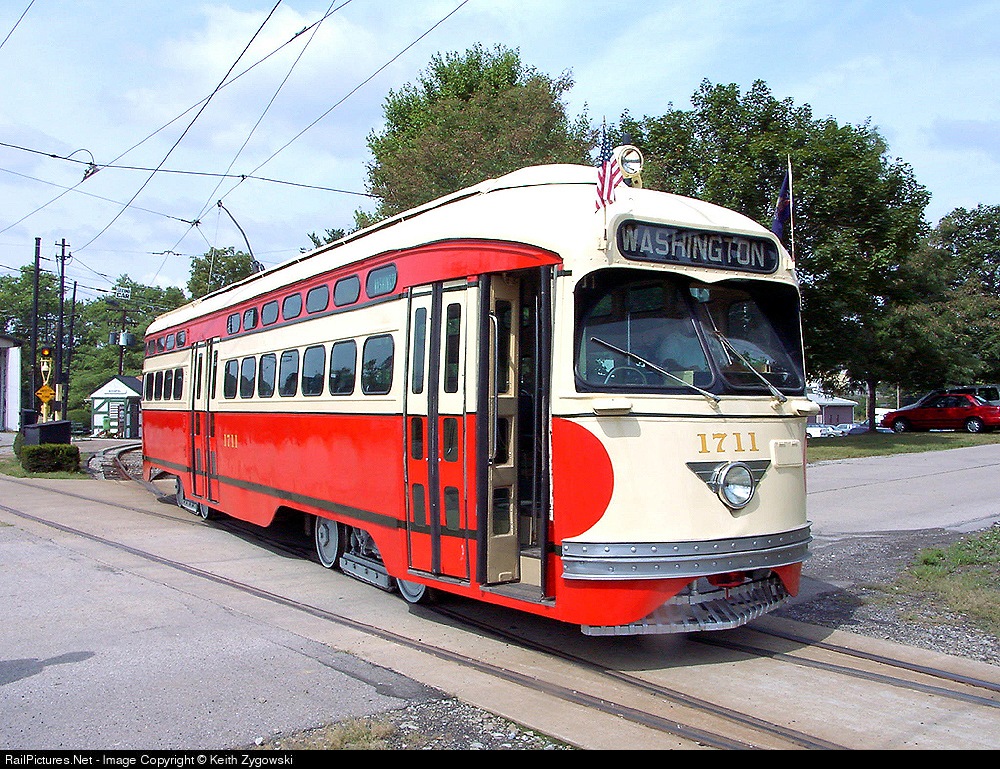
These and other systems have capitalized on the nostalgia aspect of trolleys.  Many lines use either heritage equipment (like San Francisco’s fleet of PCC cars) or new equipment made to look old (like TECO and Little Rock).  It would bring back a lot of memories for Pittsburghers to see trolleys like this


 or this


There is certainly something to be said for marketing your operation correctly and nostalgia is certainly a good way to do it.  However, nothing beats ease of use and good inter-connection.  I like the idea that it spans the entire length of the Strip from downtown all the way to Lawrenceville.  It would be a great way for a Lawrenceville or Strip resident to get downtown or move between the neighborhoods.  

However, the key question which isn’t really addressed here is;  how do you get to the trolley if you’re not one of these residents?  What are it’s connections?  I know there is talk of another trolley circulator to Oakland but that’s a topic for later.  How will someone from the Southside, or the South Hills make use of this trolley without driving to a parking lot in the Strip or Lawrenceville?   The T would make a great connector, but with AVR seemingly going all the way Steel Plaza, that takes away that option. 

Additionally how will someone from Oakland, or Hazelwood, or East Liberty or Garfield get to this line without driving?

 It can be done, after all we’ve got the East Busway for the east end neighborhoods, and supposedly this commuter rail will be an option for people coming from the South, but how this will be integrated and implemented are important discussions that could make or break this operation. 

Lastly, I don't like the idea of putting it on Penn Ave.  I know the plan is to use the circulator to take cars off the streets, in particular Penn Ave. in the Strip.   As a transit guy, I know I’m supposed to believe that putting down rails will take cars off the roads, and I DO believe that.  However, I’m a realist and know a lot of people drive to the Strip on the weekends and that a lot of people will continue to do that as a lot of them are NOT city residents but in fact suburbanites.  I also know that it’s basically bumper to bumper traffic from about 25th St. down through 16th on a Saturday morning.  I think over time that will change but the change will not be immediate.  I think you can get nearly the same effect by putting two tracks in Smallman St. and letting Penn Ave alone.  That said:  it’s not a stake in the heart of the idea. 

The second issue is more of a practical nature.  If you have one track on Smallman and one on Penn, you are creating two at grade crossings of the AVR’s commuter line should it follow its proposed route on 26th St.  Two rail operations crossing at grade are more complex than a road crossing a railroad at grade.  It involves more circuitry, and electronic systems to accomplish.  Why do it twice within a few blocks, making redundant systems when you can do it once, on Smallman St?  You’re not chasing passengers away by having the route one block away with the relatively narrow blocks in the Strip, and you’re saving money on implementation and operating costs. 

Overall, I'm clearly on board with this.  I think it's a great idea and the Strip is a great place to do it.  However, there are some issues that will have to be fleshed out before this aspect of the Riverfront plan could be implemented.  


I was going to cover the additional circulator to Oakland in this post, but seems as though I am rambling and will probably cover that and the “proposed” North Hills to Hazelwood commuter line at the same time. 

Next up:  Water Taxi


*As an aside, that was a major failure with earlier re-development projects in the Pittsburgh area.  The water front is nothing more than a dressed up strip mall with oceans of pavement.  The South Side works, although denser development has few options for transit and no room for transit expansion.  

Monday, February 14, 2011

Lawrenceville Greenway

A full report's finally available on the city's plan for the new "Greenway" which would extend from the DLC to the city line.

Not all of it's transit related, but there are some interesting nuggets, including a trolley "circulator" between Dahntahn and Lawrenceville, some sort of additional circulator between Lawrenceville and Oakland   The oft mentioned commuter rail has popped up once again.  This time including an extension on the old CSX P&W subdivision between Allison Park and Hazelwood (huh?)

I'll have more to say later, but in the mean time; here's the link.

Monday, December 20, 2010

AVR Commuter Rail Operations Part 3

Vehicles


The end is in sight! 
This final portion of my series on the proposed AVR Commuter line will cover equipment.  It’s been decided, for better or worse, that the AVR’s plan will not use an FRA-compliant heavy DMU, ala US Railcar.  Instead they will use a light DMU.  There are plenty on the market in Europe, and there are several operating examples in the United States. 

I’ve quoted the RiverLine a lot and they use a version of Stadler “GTW” line of vehicle.  This line is also used by Capital Metro in Austin, TX, and is the proposed vehicle for a new start up service in Denton County Texas. 

Other manufacturers with a foothold in North America include Siemens Mobility, whose Desiro design is used by Southern California’s Sprinter service and Bombardier whose Talent vehicle was chosen for Ottawa’s “O-Train”.

To be honest, that’s about the extent of the information.  Plenty of company propaganda, but little other information.  I’m not privy, of course, to pricing and what types of options the AVR would include, but if they’re married to a light DMU, then there are at least a number of options to choose from.  


Tuesday, November 30, 2010

AVR Commuter Rail Operations Part 2

Signaling

First off, in a different post I used the traffic light analogy when describing a railroad signaling system.  That’s partially right.  For a much better and in depth description of railroad signaling, and different types of railroad signal, check this out. 

As it stands right now, none of the current AVR line mentioned in this proposal is signaled.  Signals were removed from this route back in the PRR days.  This means not only that all the signals and associated relay equipment will have to be re-installed, but any other remotely controlled switches/derails*/automatic stops** etc.  and their associated relay equipment would have to be installed.  This is a normal cost associated with setting up a commuter operation. 

Additionally, special signaling would have to be supplied for the portion that runs at-grade on 26th street and on the Busway. 

Here’s the good news.  A local business getting the business.  Union Switch and Signal (a part of Ansaldo) has their headquarters in the city.  This sounds like a match made in heaven to me. 

The signaling concept is pretty easy and straightforward.  A light rail operation can use similar rules and signaling with a few modifications (mainly derails and Automatic train control devices).  Aside from cost, there is little that would be more challenging than a heavy commuter line, or any other light rail for that matter.

*Apparently derails are required at controlled points where a heavy rail operation interlocks with a light rail operation.  These devices will prevent an improperly directed train from entering  prohibited territory.

**  Automatic train control devices would be required at all interlockings.  If a train does not have permission to proceed through the interlocking (by the signal protecting the interlocking), then an automatic train control device would kick in and stop the train.  These devices require both rail vehicle modification and additional lineside equipment.  

Monday, November 22, 2010

AVR Commuter Rail Operations Part 1

Ok,  I’m FINALLY getting to this.  I know there’s a lot going on, and a lot of it is negative.  I’d like to focus on something that is moving forward, at least for the time being.  I was going to do this in one post, but it got a little O.O.C. so it’ll be broken up into three. 

Dispatching

Before I get into the whole light rail/freight separation thing, we can get the “easy stuff” out of the way.  Dispatching of this operation would be vary very little from dispatching a “heavy rail” operation.  A dispatcher would oversee operation, line signals and manage the movement and protection of the trains.  The bigger question is who would run it.  I can’t say for sure if AVR has dispatching factored into its annual operating cost in its study of this service.  I do know that they will be on the hook for it.  I would be very surprised if CSX would take on this responsibility, and there’s no way the NS would get involved.  Additionally, as The Trib so wonderfully put it, they wouldn’t want to burden the Port Authority with any further responsibility, so the AVR looks to be on the hook for all operations including dispatching.  A cost issue, which must be taken into account is night-time operations.  If a signal system is installed (it would have to be) it can’t just be shut off at night.  It takes written FRA approval to shut down a signaling system.  That means that the lone night time train would require a third shift dispatcher.  Hardly an effective use of money. 

The next question is what operating rules they would use.  NORAC would make the most obvious choice, and is used by NJT on their RiverLine.  Most other rulebooks are railroad specific, but NORAC provides rules which are used by multiple railroads, especially in the Northeast/Mid Atlantic region. 

Time Seperations

I’ve talked a lot about light rail intermixed with freight traffic and I’m not a big fan of these types of operations, except in cases where the freight operating window is very narrow (think a few hours) because of the FRA requirement of a “temporal separation” between freight traffic and light-rail passenger operations.  If you’re going to run a commuter service, then in my mind it should be heavy rail, but that’s another discussion for another post. 

If this operation is envisioned to be a purely commuter style operation, then the separation called for by the FRA isn’t a big problem.  Passenger trains would operate mostly into the city during the day and out of the city at night.  Operations would end probably somewhere around 8 or 9 PM, allowing the AVR to serve its customers, and would then begin early in the morning. 

The problem with this is, however, it limits the operation’s effectiveness for TOD and also in getting people out of their cars on nights and weekends.  What’s the attraction to living close to transit that doesn’t operate when you need it (outside of work)?

If this operation is to be, as some have painted it, as an intra-city link to move people from downtown to the Strip/Lawrenceville area, then this could be a challenge (not to mention I question this operation’s value in that capacity).  A subsequent separation or several separations would have to occur on a daily basis for this to work.  For example, a certain portion of the line (say above Oakmont) could be made available for freight operation after a given time (10 PM for example), while the southern portion could remain off-limits to freight until a later time (1 AM, for example).  One problem with this, however, is that the northern portion of the line is isolated.  AVR trains must enter at one of two spots, the first around 33rd St. which uses their own rails, or via NS’s Brilliant Branch, which would require further trackage rights and an extended back-up move. 

To accomplish this, another window would have to be established, earlier, say after rush hour but before the “nightlife” kicks in.  Passenger operations would have to be banned entirely during this period and all passenger equipment clear of the line and properly secured.  The AVR could then enter the line and travel north towards New Kensington.  Once the train cleared a certain point (say a controlled point in or around Oakmont) AND a certain time was reached, passenger operations could then resume on the southern portion of the line until later that evening, when passenger operations would be suspended for the evening and the AVR could service customers south of Oakmont.  See the list below for a (hopefully) better explanation.

6AM to 7 PM-Passenger only operation.  No freight operation allowed*
7 PM to 8 PM-Freight only operation, no passenger operation allowed**
8PM to 1 AM-North of Oakmont:  Freight only operation, no passenger operation allowed. 
8PM to 1 AM-South of Oakmont:  Passenger only operation, no passenger operation allowed.
1 AM to 6 AM Freight only, no passenger operations   

Clearly it’s doable but complicated.  I’ve heard of an FRA waiver that could be applied for to allow simultaneous operation, but I don’t know how practical this is considering NJT’s RiverLine was supposed to be operated in this manner but could is still operated with the time separation after 6+ years of operation. 

*EDIT*
I did a little more digging and found out that the RiverLine is operating under waivers.  However, it's not as straightforward as I thought.  Apparently a waiver is required just to let freight trains use an interlocking or controlled point that has a physical connection to the RiverLine (ridiculous).  Additionally, it appears that a waiver is required for a freight train to even operate on a separate but parallel track to an active light rail track (also ridiculous).  New Jersey Transit and Conrail were approved for these waivers and are operating under them, but these waivers do NOT allow for freight traffic to operate on the same track at the same time as passenger traffic.

These waivers would certainly have an effect on AVR's operation.  The freight would have to enter at a controlled point, remotely controlled by a dispatcher.


View AVR Freight Connection in a larger map

 The AVR also has a track that continues over the Allegheny River and interchanges with the Buffalo and Pittsburgh at Bakerstown, PA.  Because this line (the former B&O Railroad P&W sub) sees freight traffic on an as needed basis and because there is a physical connection between this line and AVR's proposed service, a waiver would be required.

The whole issue of temporal separation could be avoided by dedicating one track to freight and one to passenger.  The line was at one time double track so it is possible, but again, some sort of waiver would be required.  


*This means that no heavy freight cars, engines or trains can move on or occupy any main track, and must be secured against movement

**This means that no passenger trains can move on or occupy any main track, and must be secured against movement.

Tuesday, November 16, 2010

AVR Commuter News

Fisrt things first, I am really going to finish my “expert” analysis of the AVR’s Commuter line, I swear.

In the meantinme…

The AVR Rail proposal has popped up again.  The city got a grant for redevelopment or greening of a ribbon of land heading from the Strip through Lawrenceville. 

Check out the article here.

.The total funding was $1.5 million.  It isn’t explicitly stated, but the most of the amount seems to be going to building the greenway.  Relocating sidings and industries is noted, but that seems to allow for the greenway, not to facilitate commuter rail.

Still, the fact remains that AVR’s commuter service was mentioned hand in hand with this.  Questions of funding still remain un-answered, and because there is currently no public money involved, there is no study or project plan available to the public. 

This is all well and good, but again, I see limited value in integrating this into the greenway.  I am not questioning the greenway or the value of building up our transit infrastructure, I am merely questioning the value of AVR’s proposal to making transportation better IN Pittsburgh.  A commuter style route to the suburbs is fine for, well, commuters, but not to bring residents to another neighborhood in the city.  What you'll most likely end up with is residents of the city using buses, driving or biking to reach this new development when all is said and done.  

Thursday, July 29, 2010

Breaking Down the AVR Proposal Part 1


I’ve been critical of AVR’s plan for commuter rail.  That’s not to say that there isn’t value to what they are doing.  With that in mind I’ve put together some of what I feel are issues/risks/opportunities for this proposal.  I broke the proposal down into construction and operation.  The first installment will cover construction and each section will lay out potential issues and opportunities (if applicable) 

Keep in mind as well, there is no public report available for this.  I’ve gathered my ideas and thoughts through articles and material available on the internet.  There are no concrete figures save the $171million “private loan” and the $228 million overall cost.  Beyond that, there is currently no detail available. 

Construction

Stations

There aren’t many major issues with the construction of stations from Arnold, PA to 26th St. in the Strip. 

There are just a couple of concerns that I think it is important to highlight.

Tarentum Bridge Stop:  One of the issues AVR has apparently taken with the current Commuter Rail study is the lack of a stop past the current end of track in Arnold, PA.  They want to extend the route, approximately a mile north along the river to a stop around the Tarentum Bridge.    


While I don’t have a problem with this in theory, geography makes implementation tricky, and probably expensive.  The east side of the Allegheny River under the bridge is just a thin strip of flat land, with a steep hillside to one side and the river to the other.  There is enough land for at least one track, as this is the former PRR Railroad Allegheny Division right of way.  The tracks are gone, but the right of way is still intact.  However, there is little room for a station with parking and multiple tracks.  Additionally, gaining auto access to this strip of land would be challenging.  If the designers envision direct access from the Tarentum bridge (which I am guessing they will), steep ramps will have to be built from the bridge.  These ramps will need to provide enough clearance for Tugs to operate underneath them.  It can be done, but it would be expensive.  Again, there is no word whether this cost is included in the $228 million figure quoted in the Trib/Post Gazette. 

Another option that could be used would be to either make an access road off of Lower Braeburn Road in Lower Burrell or move the station further north so that it would be situated at the bottom of Lower Braeburn Road.  Both of these have potential issues as well.  I am still not sure there’s enough room underneath the bridge itself for a station, even without using ramps off of the bridge.  Also, with the second option, you will lose the convenience option.  I am betting they are trying to capitalize on the ease of travel to the Tarentum Bridge and therefore maximize on ridership.  If people have to drive out of their way to get to a station that is isolated by geography then there is no real reason to spend the money to put it there.

26th St. Intermodal Terminal:  26th Street is a decision point for the AVR.  They will either keep to their ROW to 16th street, or leave their right of way at 26th St, travel at grade on 26th street and join the Busway on the far side of Liberty.  

If the latter is chosen, this point could become particularly important.  According to this idea, an intermodal terminal would be built at 26th street and the AVR would possibly interchange with an LRT line coming up from downtown (don’t ask me how this would happen…)

The nearby property owners will become important in this instance.  A light rail vehicle can’t just hang a left at an intersection and the Strip is filled with dense development..  To get an idea of what it takes to turn a light rail vehicle, see the below map.


  Land will have to be acquired and buildings potentially demolished.  This is sure to meet with resistance from local business/property owners.  This will add to the already expensive costs of terminal facility construction in an urban environment.

Right of Way Construction:

One advantage that AVR has is that of an existing ROW.  (ahh the joys of existing infrastructure).  They already own the property and the tracks.  All they have to do is upgrade it.  They will have to add stations, passing sidings, signaling, and probably upgrade the road crossing protection over what they currently have.  While still expensive, the hard part (ROW acquisition) is already taken care of. 

That is until…

you get to 26th St. 
As discussed before, the AVR may elect to continue using their right of way and easement to reach 16th St.  If this is the case, while not ideal for operations it is ideal from a cost standpoint. 

The other option would be to operate at grade on 26th St. across Liberty where it would run on (or alongside) the Busway to the Penn Center Station and onto Steel Plaza.  This option could end up being very costly, and may not be physically feasible at all. 


As I alluded to earlier, a train doesn’t turn on a dime.  The line would have to curve to meet 26th St, and again, would probably have to cross a privately owned parking lot.  The AVR would then need permission to dig up the entirety of 26th Street to lay rail.  This would involve closing off Liberty Ave and Penn Ave to dig up the pavement and lay rails. 

I don’t know the timeframe for how long these roads would have to be disrupted for or the cost to install rails and update the traffic control equipment (both for auto traffic and trains). 

The going gets tougher once across Liberty Ave.  There is currently a bridge across the NS Pittsburgh Line that buses use to access the Busway.  There is a grade after Liberty to get over this bridge.  If trains are to use this they must make sure the grade is not too steep to operate.  They also have to ensure that the bridge is rated.  Remember, Light Rail is a relative term (River LINE style cars are approx 20 tons) and they are crossing a highway style bridge.  Assuming those requirements are met the ramp will have to be dug up and tracks laid.

The next challenge is the Busway itself.  After having to emplace a hard right hand curve at the Busway end of the bridge, the line will have to deal with the Busway itself.  This is not privately owned and is owned by the Port Authority.  They must agree to allow tracks to be put into place on their route.  (There is also no indication whether PAT will or won’t be responsible for operating this AVR service).  Again, IF PAT agrees to this request, the Busway will have to be torn up and tracks laid.   As the route would near the Penn Center Station, there is more room and the two routes could operate parallel to each other. 

An additional problem would face this proposal south of the Penn Center Station.  Soon after the station, the T ROW into Steel Plaza goes underground and stays that way for the 1000 or so feet to Steel Plaza.  This would mean that diesel propulsion may not be practical.  At the very least cars would not be allowed to idle in Steel Plaza, and may not be able to be operated underground at all without an electrical back up or third rail system.  Although this would be a short distance requirement, it still would mean additional infrastructure and vehicle costs.  Also, tracks would have to be re-laid because of gauge difference. 

A final construction issue is future T service to the East.  I know it’s a pipe dream, but there has always been talk of making the East Busway into a T line.  Right now that possibility will always be there.  If you built a different gauge line in from the East, you are removing that possibility. 

It’s clear there are some challenges.  I like the idea of the line going all the way to Steel Plaza.  This line is unlikely to ever be able to link in with a like mode of transportation.  Giving people ready access to the T and East Busway to get elsewhere in the city is critical if this service is going to succeed.  It’ seems as though construction is feasible.  The question right now is; is it practical?  

Tuesday, July 20, 2010

AVR "River Line" Map

Check ahhhht this new Google Map of AVR's proposed transit line, which I have nick-named the "AVR River Line" after NJT's version from Trenton to Camden, NJ.


View AVR's "River Line" in a larger map

Coming soon:  a breakdown of the challenges/opportunities for AVR's proposal.

Friday, July 16, 2010

The AVR Saga Continues

I couldn’t resist.  I had to write something after I saw the latest Article in the Trib about the AVR.*  As if that wasn’t enough, there was a follow up article in the City Paper. 

To sum it up: AVR wants to implement service from Arnold to  Steel City Plaza via their current right of way from Arnold to the Strip, breaking off (and I’m assuming) using street trackage on 26th St, crossing Liberty and using the East Busway to gain access to Steel Plaza.  They want to do this because: #1 They feel access to Steel Plaza will provide the greatest intermodality (can’t argue that, given the context) and #2 struggles with property owner below 21st ST (Buncher) continue, even though the STB ruled in favor of AVR owning the easement to their ROW in the lower Strip. 

A couple thoughts on the Trib article: 
I wonder if the Allegheny/Westmoreland County commuter proposal has really “lost steam” as the article suggests.  Granted, not much has been said about it lately, but throughout this planning process, there have been large gaps in time between updates. 

I also get the impression that really no one is on board with the AVR’s proposal, accept the AVR.  County and Port Authority officials seem to be awfully quiet about the whole thing. 

Then the City Paper article popped up.  This article brought up further issues, such as the proposed Buncher TOD development in the Strip.  Included in this was talk of an LRT line to Lawrenceville.  Additionally, the article questioned the validity and thoroughness of AVR’s study on connecting their transit line with Steel City Plaza.  There was no mention of the Allegheny/Westmoreland Commuter Rail proposal in this article. 

A couple thoughts on the CP article:  
Wow, the plot thickens.  I had seen articles about the proposed development in the Strip but had not heard talk about an LRT line to Lawrenceville.  I have to wonder where exactly that all came from (aside from Patrick Dowd’s mouth).  Considering PAT nixed the convention center spur, I don’t know how likely this line to Lawrenceville would be.  I’m certainly not opposed to the idea; however, I'm not holding my breath for them to build one.  Consider that the first Spine Line Study was completed in 1993.  Nearly twenty years later, we are close to having a tiny portion of what was supposed to be the Spine Line (The NSC).

My overall thoughts:  
There have been many developments in a short amount of time.  In addition, I’m not exactly sure what is really going on vs. what is conjecture.  Nothing is guaranteed at this point, not even AVR’s plan.  Dowd’s comments are right on about wanting to increase connectivity within the city, not just into and out of the city.  For my money, I’d rather see an extension to Oakland, transformation of the busway to LRT, or an LRT line to Lawrenceville through the strip before commuter rail. 

Additionally, I have to wonder where the commuter rail plan stands.  Again, if AVR forges ahead as is, they will be creating a single line transit system that will be limited in how it can tie in with other forms of transportation within the region.  You will never have a system of these lines in Pittsburgh where you can get from one point in the region to another (beyond Arnold to Pittsburgh).  A heavy type commuter rail would at least give the ability to operate inter-mixed with freight traffic, and would make the dream of having a system from one end of the county to the other at least a possibility.  As unlikely as that may seem, it is still MORE likely than a similar system using River Line style light rail. 

Having said that, any project that would decrease the number of vehicles on the road and the amount of time that people spend in cars would be welcome.  Commuter rail can spur TOD.  If someone moves to a walkable community near a train station from a suburban cul de sac because it provides access to the city that in itself is a victory.  Oakmont isn’t in the city, but it’s a perfect, ready made TOD community (with the exception of a super market, but I digress).  It would certainly not be a bad thing to expand a walkable community like Oakmont. 

Additionally, as a commenter In the City Paper article suggests, a golden opportunity to generate support for a commuting alternative is being missed here.  Route 28 sees 60,000 cars a day.  Route 28 is also undergoing major construction.  If even 10% of those people are convinced to try AVR’s transit line, that would be a great start to establishing a well patronized and effective commuter alternative.  If some sort of system were not started until, say 2014-2015 time frame, then people would be much less likely to ditch their cars.


As always, I guess the bottom line is:  The more we stand around and talk, the more things don’t change.


*As an aside, I like how the Trib gets their barbs in there specifically about the Port Authority and publicly funded transportation. 
Specifically: 
“Ardolino said the venture would not ask for funding from the cash-strapped transit agency.
"We're trying to keep Port Authority out of this equation," he said. "They have a role, but we'd rather not burden the authority any further."”

Then the subtle jab against publicly funded transportation at the end:
 "I'd be all for it if it would be mostly self-supporting,"
 Of all the quotes during interviews, I find it curious that this one is the one they would include...  

Thursday, June 3, 2010

Back from the Dead

Ok, I wasn’t really dead, just consumed with life outside of blogging.
A lot has happened in a short amount of time with the planned commuter rail plan for Arnold/Greensburg.

The story first appeared here and has become significantly more complex in the mean time. Apparently, not only has AVR secured financing for the Arnold to Pittsburgh line, but they intend to move forward with it, and are at least exploring other options for its operation. i.e. potentially pursuing a River Line style (light) of operation vs. a WES or Tri Rail operation. (heavy).

I’m not sure what to think of this. If you read the AVR proposal they have their own ideas on implementation, and basically don’t care what Allegheny or Westmoreland County think.

I can see two perspectives on this:

-AVR is trying to grease the skids so to speak. They (as I am) are not impressed with the pace of the overall project while costs escalate and the Rte 28 project progresses. Because this news is so out of left field I would not be surprised if this is in fact the case. This is what I hope is really happening. In fact, I hope it works. We’re on our tenth year of talking about this, and I see this having the potential to go the way of every other transit project in Pittsburgh if action is not taken.  (That place is no where)

- AVR is serious about this propsal.  I REALLY hope that they aren't serious about their proposal. I say that because a light rail style of operation, whether diesel or electric severely limits its interaction with either a Greensburg line operation or Bill Peduto’s shuttle, or any other standard rail line for that matter. Currently, operations such as the River Line must be segregated, by time from heavy operations. Meaning, if light operations occur from 5 AM to 7PM for example, then no heavy trains can operate on that trackage during that time and visa verse. This is fine for the AVR tracks, but not good for tying in with the NS (Greensburg) or Amtrak/CSX (Peduto Limited). If the AVR gets their way, then their operation will be forced to be a stand alone operation, even if some other commuter operation would come to fruition. Basically, you would have yet another mode of operation that does not tie in well with any other operation. That greatly decreases the operation’s effectiveness and chances it could operate successfully. No word on whether they expect to receive operating subsidies, or whether they expect to be able to operate at a profit.